
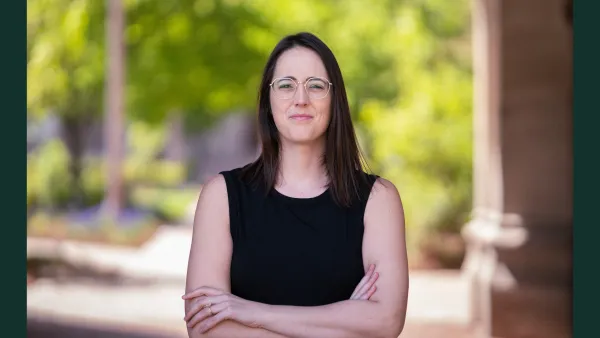
Bridget Kelly, currently completing her PhD at WashU, received an American Association of University Women (AAUW) American Dissertation Fellowship for 2025-2026 for her dissertation project, The Harlem Uprising of 1943: Black Self-Determination and the Formation of Probationary Citizenship.
What does the AAUW Fellowship mean for you and your research?

This fellowship is deeply meaningful to me, both personally and professionally. It connects my work to a long lineage of women scholars who have expanded the boundaries of academic research. At a moment when funding for the humanities is increasingly scarce, I feel honored that the AAUW recognizes the importance of my project and its contributions to understanding the intersections of law, freedom, and citizenship.
Could you tell us briefly about your dissertation project? What drew you to this topic?
The Harlem Uprising of 1943: Black Self-Determination and the Formation of Probationary Citizenship, starts with what’s often called a wartime “riot” in Harlem—but it tells a much bigger story. It’s about the Black migrants from across the U.S. and the world who came to Harlem to build a modern Black city, and the demands and sacrifices they made to confront exploitation and abuse.
I first came to the topic when my advisor, Iver Bernstein, suggested I visit the New York Municipal Archives and “see what I find.” I’d planned to write about Black suburbanization, but when I discovered the probation records of those arrested during the uprising, I knew I had to tell the story of Harlem in 1943. Many of the men’s cases had literally been “transferred” to the U.S. Army, their freedom made contingent on military service. That discovery revealed a far more complicated story about race, war, and the conditional terms of citizenship in mid-century America.
How has the fellowship changed your approach to your work this year?
This fellowship has given me the time and security to focus fully on finishing my dissertation which feels especially meaningful at a moment when academic freedom and funding are under real strain. It’s also been a vote of confidence in my work and a reminder that the questions I’m asking matter. As I prepare to go on the job market, that support feels both grounding and encouraging. I’m hopeful it’s a good sign that I’ll find the right academic home where I can continue to teach, research, and grow as a scholar.
What do you hope others take away from your work?
I hope readers come away seeing that events often dismissed as “riots” or “disorder” were, in fact, powerful expressions of political imagination and self-determination. My work invites people to think differently about how freedom is defined—and who gets to claim it. More broadly, I hope it reminds people that history isn’t just about the past; it’s about understanding how ordinary people have always organized, defended themselves and their neighborhoods, and reimagined what freedom and justice could look like.
I hope my research encourages others to question familiar narratives about citizenship, belonging, progress, and order. By tracing how systems of surveillance and control evolved alongside movements for equality, I hope to reveal the complexity—and the courage—at the heart of struggles for freedom in America.
Bridget Kelly’s research also took her to the recent American Historical Association conference which took place in January 2025 in New York City. She organized a panel, “Law and Order Policing in New York,” where she presented her dissertation research. Emily Brooks, author of Gotham’s War Within a War and Shannon King who wrote The Politics of Safety and Whose Harlem is It Anyway? also presented their work. Elizabeth Kai Hinton, historian at Yale and author of America on Fire and From the War on Poverty to the War on Crime chaired the panel.

Access her research below:
The Materiality of Belonging: Black Property Claims after the Civil War
"I Get So Made Cause We Ain't Got No Freedom": Black Women, Rage, and the Harlem Uprising of 1943
Harlem in Disorder: A Spatial History of How Racial Violence changed in 1935 (By Stephen Robertson)


