Recently, several publications have been produced by faculty in history.

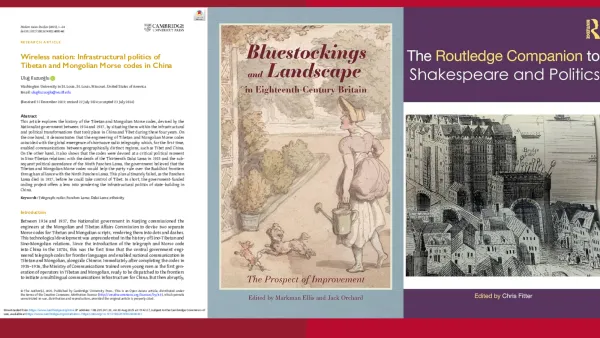
Uluğ Kuzuoğlu released Wireless Nation: Infrastructural politics of Tibetan and Mongolian More Codes in China.
This article explores the history of the Tibetan and Mongolian Morse codes, devised by the Nationalist government between 1934 and 1937, by situating them within the infrastructural and political transformations that took place in China and Tibet during these four years. On the one hand, it demonstrates that the engineering of Tibetan and Mongolian Morse codes coincided with the global emergence of shortwave radio telegraphy which, for the first time, enabled communications between geographically distinct regions, such as Tibet and China. On the other hand, it also shows that the codes were devised at a critical political moment in Sino-Tibetan relations: with the death of the Thirteenth Dalai Lama in 1933 and the subsequent political ascendance of the Ninth Panchen Lama, the government believed that the Tibetan and Mongolian Morse codes would help the party rule over the Buddhist frontiers through an alliance with the Ninth Panchen Lama. This plan ultimately failed, as the Panchen Lama died in 1937, before he could take control of Tibet. In short, the government-funded coding project offers a lens into pondering the infrastructural politics of state-building in China (Academia.edu).

Steve Hindle has contributed to several publications, including a chapter in Bluestockings and Landscape, titled “Idioms of Improvement: Gender and Social Relations on the Montague Estates, 1730-1800”.
Situated within the broader context of eighteenth-century intellectual and cultural history, this collection redefines the role of the Bluestocking circle in shaping Britain’s landscapes and social ideals. Against the backdrop of Whiggish notions of “improvement”-encompassing agricultural innovation, aesthetic refinement, and moral progress-it explores how women such as Elizabeth Montagu, Mary Delany, and Elizabeth Carter navigated the intersections of polite sociability, intellectual production, and estate management. Their contributions reveal a dynamic interplay between cultural critique and practical reform, positioning them as active participants in the period’s debates on land, labour, and national identity (Boydell and Brewer).
He also contributed a chapter in the recently published The Routledge Companion to Shakespeare and Politics, titled “Shakespeare and the People: Staging Political Economy.”
This chapter takes the exchange between the hungry crowd and a paternalistic magistrate staged in Act 1 Scene 1 of Coriolanus (1608) as the point of departure for an analysis of five idioms of social and economic inequality in which relations between governors and governed were expressed in early modern England: successively, social differentiation, material distress, food insecurity, market dislocation, and popular protest. (Taylor & Francis Group).